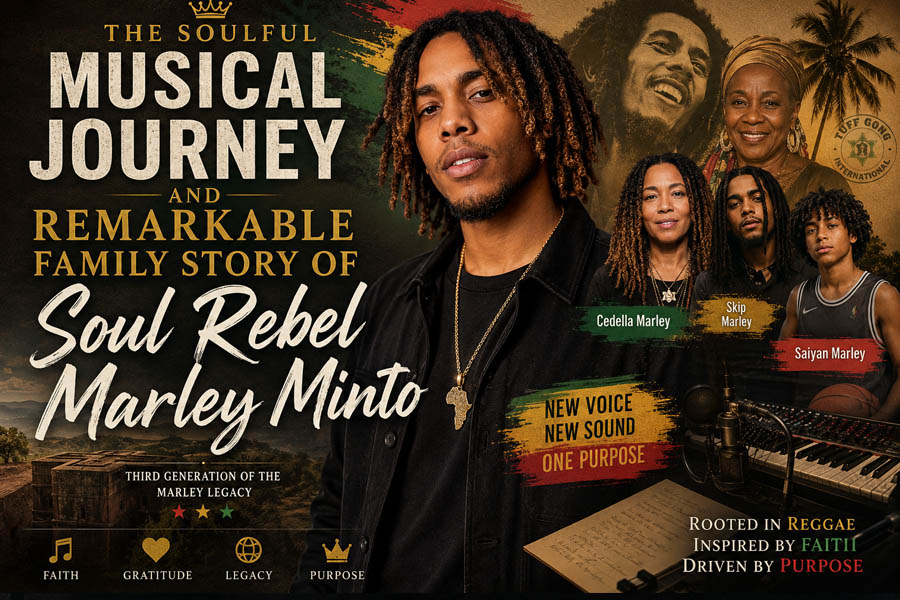
Growing Up Inside the Marley Musical Legacy
When I look at the story of Soul Rebel Marley Minto, I see a young artist growing inside one of the most recognizable musical families in the world while gradually learning how to create a sound that belongs to him. As a member of the third generation of the Marley family, Soul Rebel inherited more than a famous surname. He inherited a living musical tradition shaped by reggae, spirituality, Jamaican culture, family, and an enduring belief in music as a vehicle for purpose.
Soul Rebel is the son of Cedella Marley and David Minto and the grandson of reggae legend Bob Marley and Rita Marley. He is one of three sons raised by Cedella and David, alongside recording artist Skip Marley and Saiyan Marley. Although his exact birth date and age are not widely publicized, his place within the Marley family has become increasingly visible since his emergence as a recording artist in 2025.
Music was never something distant in his childhood. It surrounded him from an early age, and he has described experiencing music almost continuously, from inside the womb to the world beyond it. He began playing piano at about 6 years old and later taught himself guitar. The instruments became his tools for exploring ideas rather than simply reproducing the music of his relatives.
The Influence of Cedella Marley and David Minto
Soul Rebel’s mother, Cedella Marley, was born on August 23, 1967, in Kingston, Jamaica. She was the first biological child of Bob and Rita Marley and became an important part of the Marley family’s musical and entrepreneurial story.
Cedella performed with the Melody Makers alongside her siblings Ziggy, Stephen, and Sharon. The group became internationally successful and earned three Grammy Awards. Cedella later expanded her work into fashion, publishing, business, philanthropy, and football advocacy. She has also served as CEO of Tuff Gong International, an important institution within the Marley family’s musical infrastructure.
For Soul Rebel, Cedella was not simply a famous parent. She was a working musician whose creative environment provided a first-hand education. He could observe rehearsals, performances, studio sessions, touring, and the practical discipline required to maintain a musical career.
His father, David Minto, married Cedella in 1993. Public information about David is considerably more limited, but the couple’s family life produced three sons and connected another generation to the Marley story.
His Brothers Skip Marley and Saiyan Marley
Soul Rebel’s closest musical relationships include his two brothers.
Skip Marley, born June 4, 1996, has established himself as a recording artist in his own right. His career includes internationally recognized songs, collaborations, performances, and Grammy attention. Skip and Soul Rebel have also worked together creatively, including studio sessions that helped inspire Soul Rebel’s eventual transition from producer to recording artist.
Saiyan Marley, born April 23, 2003, is the youngest of Cedella and David’s three sons. He has been associated with modeling, athletics, and basketball, and he also appears in Soul Rebel’s musical world. Saiyan featured in the video for “Holy Father,” making the project another visible example of the family’s ability to combine music, culture, and shared identity.
I find the relationship between the brothers particularly interesting because each has followed a somewhat different path. Skip became an established recording artist, Saiyan explored interests outside music, and Soul Rebel spent years developing his abilities behind the scenes before stepping forward himself.
The Wider Marley Family
Soul Rebel’s family tree spans multiple generations of Jamaican musical history.
His grandparents were Bob and Rita Marley. Bob Marley, born Robert Nesta Marley in 1945, was one of the most prominent artists in reggae music before his death in 1981. His music introduced Jamaican rhythms to a global audience while exploring themes such as faith, justice, freedom, love, and human dignity.
Rita Marley also became a singer, performer, philanthropist, and a key steward of the Marley heritage. Bob and Rita created a family whose influence lasted long after Bob died.
Soul Rebel is thus linked to a vast network of musicians and cultural people. Sharon Marley, Ziggy Marley, and Stephen Marley are his aunts and uncles, while the Marley family as a whole includes Damian Marley, Julian Marley, Ky-Mani Marley, and other performers.
The next generation has carried on that legacy. Selah Marley, Zion David Marley, and Joshua Omaru Marley, sometimes known as YG Marley, are some of the younger members of the extended family. Soul Rebel has also collaborated with members of this larger musical community, such as his late cousin Jo Mersa Marley and aunt Sharon Marley.
Ethiopia and a Spiritual Foundation
One of the most distinctive elements of Soul Rebel’s story is his connection with Ethiopia.
As a child, he traveled to Addis Ababa for a festival honoring his grandfather. The event reportedly attracted more than 100,000 people. For a young member of the Marley family, witnessing such a gathering could make the relationship between music, heritage, spirituality, and community feel tangible.
Ethiopia later became an important visual and spiritual setting for his own music. The rock-hewn churches of Lalibela appear prominently in the visual world surrounding his releases. Rather than using the locations merely as exotic scenery, Soul Rebel connects them with faith, history, family memory, and the spiritual vocabulary that runs through his music.
This influence is especially clear in songs such as “Loving Jah” and “Holy Father.”
From Producer to Recording Artist
Before Soul Rebel stepped into the spotlight as a singer and performer, he concentrated on production.
He developed his own imprint, Tek Time Productions, as a creative home for his work. His production background included projects involving members of the Marley family, including his cousin Jo Mersa Marley and aunt Sharon Marley.
This period gave Soul Rebel an important advantage. Instead of entering the studio as someone learning only how to sing or perform, he already understood the architecture behind a recording. He could build rhythms, arrange instruments, shape vocals, and develop complete productions.
He has described a hands-on creative process involving melodies, voice notes, riddims, and production software such as Logic Pro. In that sense, the studio became his laboratory. He could experiment privately before presenting his work publicly.
Tek Time Productions and the Meaning Behind the Imprint
Tek Time Productions is Soul Rebel’s personal production imprint and independent creative vehicle. Its public identity became particularly visible when he began releasing his own music in 2025.
The imprint works in partnership with Tuff Gong International, connecting Soul Rebel’s independent artistic direction with an organization deeply rooted in his family’s history.
The name Tek Time also fits the philosophy surrounding his career. Rather than rushing into the spotlight because of his surname, Soul Rebel spent years developing production skills and finding his voice. His journey suggests patience and deliberate craftsmanship.
The distinction is important. Being born into a famous musical family could easily create pressure to perform immediately. Soul Rebel instead appears to have taken time to develop his own artistic language.
Loving Jah Marks a New Chapter
In February 2025, Soul Rebel officially introduced himself as a recording artist with “Loving Jah.”
The song draws inspiration from Bob Marley’s “Forever Loving Jah,” originally released in 1980. Soul Rebel transformed that spiritual foundation into a contemporary production incorporating reggae, dancehall, and hip-hop influences.
The song also includes vocal contributions from his mother, Cedella Marley, creating a direct musical bridge between generations.
The story behind the song is equally personal. During a studio session with Skip, Soul Rebel developed the opening idea and captured it as a voice note. He then built the production around the vocal concept. That process reflects his identity as both musician and producer.
The lyric video’s Ethiopian imagery added another layer to the release, connecting his personal musical awakening with a place that had already influenced his childhood.
Holy Father and the Expansion of His Sound
Soul Rebel followed “Loving Jah” with “Holy Father,” a spiritually focused track incorporating Afrobeat influences.
The song centers on gratitude, faith, resilience, and overcoming obstacles. Its cinematic video was filmed in Lalibela, Ethiopia, and included appearances by Skip Marley and Saiyan Marley. Father Amde Hamilton, who had spoken at Bob Marley’s funeral, also appeared.
For me, this project illustrates how Soul Rebel uses family connections without allowing them to become the entire story. The Marley name is present, but the songs focus on his personal interpretation of spirituality and gratitude.
Remixes followed, including the Kemist Remix of “Loving Jah” and the JonFX Remix of “Holy Father.” He also expanded his catalog with later collaborations such as “Holy Water” with Steven Malcolm in 2026.
Musical Influences Beyond the Marley Family
Although Bob Marley and the Melody Makers naturally form part of Soul Rebel’s musical foundation, his influences extend well beyond reggae.
He has spoken about artists such as Drake and Lil Wayne, while also pointing to Kanye West’s production style as an influence. These references help explain why his music does not remain confined to traditional reggae arrangements.
Soul Rebel combines the roots of Jamaican music with contemporary hip-hop, dancehall, Afrobeat, and modern studio production. His sound therefore resembles a bridge between generations. One foot remains planted in the Marley musical heritage while the other reaches toward current global sounds.
Faith, Gratitude, and the Soul Rebel Identity
The name Soul Rebel captures much of his artistic philosophy.
The “Soul” side reflects spirituality, reflection, gratitude, and emotional depth. The “Rebel” side suggests independence, experimentation, and a willingness to move beyond expectations.
That balance appears throughout his music. His songs frequently return to God, purpose, perseverance, and gratitude, yet his production incorporates modern sounds rather than attempting to recreate his grandfather’s recordings.
His musical message is therefore less about imitation and more about continuation. The roots remain visible, but new branches keep growing.
A Young Marley Building His Own Path
Soul Rebel Marley Minto, unlike some of his family, maintains a rather private life. His exact birth date is not widely known, and details regarding his personal relationships are few. He does not have a well-known spouse or children, thus his public profile is not dominated by them.
Instead, music is becoming an increasingly important part of his public character.
His journey has included childhood exposure, piano training, self-taught guitar, production work, and family collaborations, culminating in a growing catalogue of unique recordings. His collaboration with Tek Time Productions provides him with creative freedom, yet his collaboration with Tuff Gong International positions his work inside a much bigger cultural history.
The journey is still evolving. As of 2026, Soul Rebel’s career was not founded on a long history of major prizes or headline successes. His greatest significant success may have been the transformation from primarily behind-the-scenes producer to an artist with a distinct spiritual and musical identity.
Soul Rebel Marley Minto Family and Career at a Glance
| Detail | Information |
|---|---|
| Full Name | Soul Rebel Marley Minto |
| Known As | Soul Rebel Marley, Soul-Rebel Marley |
| Profession | Singer, songwriter, producer, multi-instrumentalist |
| Mother | Cedella Marley |
| Father | David Minto |
| Grandparents | Bob Marley and Rita Marley |
| Brothers | Skip Marley and Saiyan Marley |
| Production Imprint | Tek Time Productions |
| Artist Debut | “Loving Jah” in February 2025 |
| Follow Up Single | “Holy Father” |
| Later Collaboration | “Holy Water” with Steven Malcolm |
| Musical Styles | Reggae, dancehall, hip-hop, Afrobeat |
| Instruments | Piano and guitar |
| Major Themes | Faith, gratitude, spirituality, family, legacy |
| Family Institution | Tuff Gong International |
FAQ
Who is Soul Rebel Marley Minto?
Soul Rebel Marley Minto is a Jamaican multi-instrumentalist, singer, songwriter, and producer. He is the son of Cedella Marley and David Minto and the grandson of Bob Marley and Rita Marley. He belongs to the third generation of the Marley musical family.
Who are Soul Rebel Marley Minto’s parents?
His parents are Cedella Marley and David Minto. Cedella is a singer, entrepreneur, author, fashion designer, philanthropist, and former member of the Grammy-winning Melody Makers. She has also served as CEO of Tuff Gong International.
Who are Soul Rebel Marley Minto’s brothers?
Soul Rebel has two brothers, Skip Marley and Saiyan Marley. Skip is an established recording artist, while Saiyan has pursued interests including athletics, basketball, and modeling and has appeared in Soul Rebel’s music video for “Holy Father.”
Is Soul Rebel Marley related to Bob Marley?
Yes. Soul Rebel Marley is the grandson of Bob Marley and Rita Marley. His mother, Cedella Marley, is one of Bob and Rita’s children.
When did Soul Rebel Marley begin his recording career?
Soul Rebel officially debuted as a recording artist in February 2025 with the single “Loving Jah.” Before that release, he had primarily worked as a producer and developed his own imprint, Tek Time Productions.
What is Tek Time Productions?
Tek Time Productions is Soul Rebel’s personal production imprint. It serves as a creative home for his self-produced music and operates in partnership with Tuff Gong International.
What is Soul Rebel Marley’s song Loving Jah about?
“Loving Jah” is a spiritually focused reggae song inspired by Bob Marley’s “Forever Loving Jah.” Soul Rebel combines reggae foundations with contemporary dancehall and hip-hop production while emphasizing faith and devotion.
Why is Ethiopia important to Soul Rebel Marley?
Ethiopia has a significant place in Soul Rebel’s personal and artistic story. He visited Addis Ababa as a child for a festival honoring his grandfather, and Ethiopia later became an important setting for his music videos, including the visual material surrounding “Loving Jah” and “Holy Father.”
What musical instruments does Soul Rebel Marley play?
He began playing piano at around 6 years old and later taught himself guitar. His work as a producer also demonstrates his broader understanding of musical arrangement, recording, and studio production.
Does Soul Rebel Marley have children?
No widely reported information identifies Soul Rebel Marley as having children of his own. His public profile is focused primarily on his music, production career, and relationships within the Marley family.