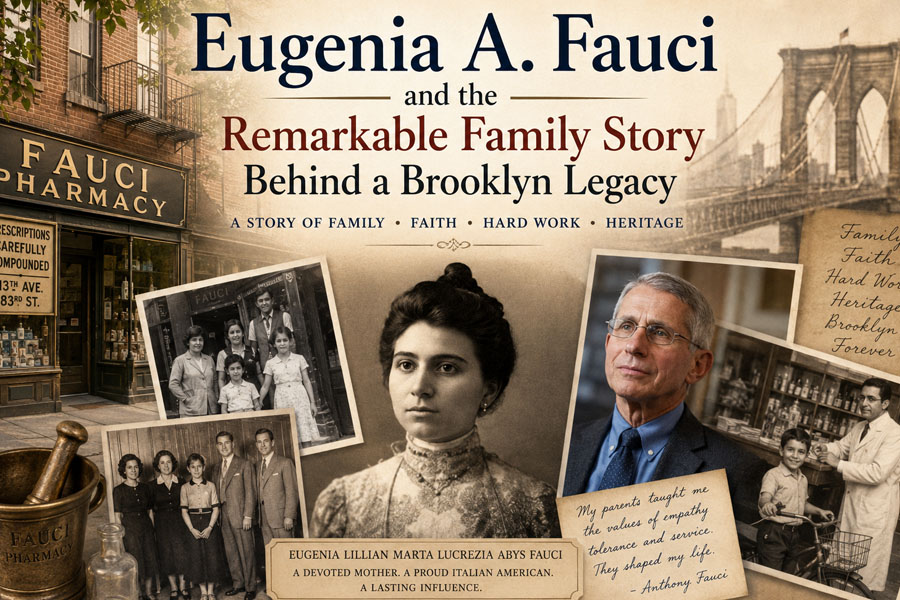
The Early Life of Eugenia A. Fauci
When I look at the life of Eugenia A. Fauci, I see a story shaped less by public recognition than by family, work, education, and community. Born Eugenia Lillian Marta Lucrezia Abys on August 3, 1909, in Manhattan, New York City, she grew up in an Italian American household whose roots stretched across the Atlantic and into the artistic and working communities of New York.
Her parents, Giovanni Abys and Raffaela Abys, brought together several cultural threads. Giovanni, who later used the American name John Robert Abys, was an artist, illustrator, painter, and commercial designer. Raffaela, also known as Raffaella Philomena Lena, was a seamstress from the Naples area. Their household reflected the experience of many immigrant families of the early twentieth century, balancing cultural traditions with the demands of building a life in America.
The 1910 census placed the young Eugenia in Manhattan with her parents and siblings. The family initially lived in the Little Italy area before later moving to Brooklyn. These neighborhoods became an important backdrop to Eugenia’s childhood and, eventually, to the life she created with her husband.
| Personal Detail | Information |
|---|---|
| Full name | Eugenia Lillian Marta Lucrezia Abys Fauci |
| Birth | August 3, 1909 |
| Birthplace | Manhattan, New York City |
| Parents | Giovanni Abys and Raffaela Abys |
| Education | Brooklyn College and Hunter College |
| Husband | Stephen A. Fauci |
| Children | Denise Lillian Fauci and Anthony Stephen Fauci |
| Death | October 29, 1965 |
| Burial | Green-Wood Cemetery, Brooklyn |
Eugenia reportedly met Stephen Fauci while they were still young students. They attended school together, beginning with the eighth grade, and eventually married when Eugenia was around 18 or 19. Their relationship became the foundation of a family that would remain closely connected to Brooklyn for decades.
A Young Marriage Built Around Family and Pharmacy Life
Eugenia’s adult life developed around the responsibilities of marriage, motherhood, education, and the family pharmacy. Her husband, Stephen A. Fauci, was born on September 11, 1910, and trained as a pharmacist at Columbia University’s College of Pharmacy.
The pharmacy became much more than a place of business. It was the family’s center of gravity.
The Fauci household was closely associated with the neighborhood pharmacy in the Bensonhurst and Dyker Heights area of Brooklyn. The family lived above or near the business, and their daily lives naturally blended with the work of serving local customers. Stephen handled the professional pharmacy responsibilities, while Eugenia contributed to the business and helped manage the register.
Their daughter Denise also worked at the register as a young person. Their son Anthony, meanwhile, delivered prescriptions by bicycle.
I find this detail especially revealing because it gives a more tangible picture of the household. Rather than imagining Anthony Fauci’s childhood only through the lens of his later scientific career, it is possible to picture a Brooklyn boy riding a bicycle through neighborhood streets with medicine in the delivery basket, returning to a family business where his parents and sister were working.
The pharmacy was a small stage on which the family’s values were practiced every day. Customers were neighbors. Work was shared. Children participated. Responsibility was learned through ordinary routines.
Eugenia A. Fauci as a Mother
Eugenia became the mother of two children, Denise Lillian Fauci and Anthony Stephen Fauci.
Denise, born around 1937 or 1938, was the older child. She later became a teacher and eventually lived in Northern Virginia. Her early participation in the family pharmacy reflected the practical character of the household.
Anthony was born on December 24, 1940, at Brooklyn Hospital. His later career would make the Fauci name internationally recognized, but his earliest world was much smaller and more intimate.
He grew up in the Bensonhurst and Dyker Heights area, in a strongly Catholic Italian American family. His descriptions of childhood have emphasized happiness, close family relationships, tolerance, empathy, and respect for other people.
Those values are important when considering Eugenia’s influence. She did not become famous herself, but motherhood placed her at the center of the environment in which those qualities were developed.
Anthony’s eventual career in medicine and public health would span decades. He became an immunologist, served as director of the National Institute of Allergy and Infectious Diseases from 1984 until 2022, and advised several American presidents. Yet behind that extraordinary professional story was a childhood rooted in an ordinary Brooklyn family.
Eugenia’s influence can therefore be understood as part of the foundation rather than the headline.
The Artistic World of Giovanni Abys
Eugenia inherited an artistic tradition from her father, Giovanni Abys.
Giovanni was born October 23, 1876, in Atripalda, near Avellino, Campania, Italy. Although he was born in Italy, family research reveals that he has Swiss Grisons lineage as well as ancient cultural links to the Alpine and northern Italian regions.
After marrying Raffaela, he moved to the United States with his family. They came on the Gallia on May 17, 1902, and settled in New York.
In America, Giovanni established himself as an artist and commercial designer. His work was said to include landscapes, portraits, commercial labels, and drawings for Italian magazines. He also worked as a designer and a drafter.
His career exemplifies an essential aspect of immigrant artistic history. Art was not always divorced from actual employment. A painter could make landscapes while also designing commercial labels. An illustrator could work for periodicals while supporting a family. Creativity and commerce frequently shared the same workstation.
Eugenia inherited Giovanni’s artistic world. She grew up in a family where visual art, craftsmanship, immigrant enterprise, and cultural identity coexisted.
The Abys Family and Its Italian American Roots
Eugenia’s mother, Raffaela Abys, came from the Naples area and worked as a seamstress. Her father’s background added another layer to the family’s identity through his connections to Switzerland and Italy.
The family eventually established itself in Brooklyn, where Eugenia grew into adulthood. Her siblings included Robert, Christina, and Emily Lenora Melici in various family records.
This background helps explain the cultural environment in which Eugenia raised her own children. The Fauci household was not simply a private family residence. It was part of a broader Italian American neighborhood network, shaped by immigration, Catholic traditions, small businesses, extended family, and strong community relationships.
The family’s story reflects a generation that had crossed borders but carried familiar customs with them. Food, faith, language, work, family loyalty, and neighborhood relationships became threads connecting the old world to the new.
Stephen Fauci and the Family Pharmacy
Stephen A. Fauci remained an important figure in Eugenia’s life until long after her death. Born in 1910, he became a pharmacist and operated the neighborhood business that supported the family.
Customers reportedly knew him affectionately as “Doc,” a fitting nickname for a neighborhood pharmacist who occupied a trusted position in community life.
Eugenia and Stephen’s marriage lasted for decades, although Eugenia’s life ended much earlier than his. She died on October 29, 1965, at only 56 years old.
Stephen survived her for more than four decades, dying on May 13, 2008. He was also buried at Green-Wood Cemetery in Brooklyn.
The contrast between their lifespans is striking. Eugenia died before her son became a nationally prominent physician. She did not live to see Anthony’s rise through medicine, infectious disease research, public service, and national leadership.
Her legacy therefore developed largely after her death.
Anthony Fauci and the Family Legacy
Anthony Stephen Fauci became the most publicly recognized member of the family.
Born in Brooklyn on December 24, 1940, he developed into one of America’s best known physicians and scientists. His career included decades of research into infectious diseases and leadership at the National Institute of Allergy and Infectious Diseases.
He married Christine Grady, a nurse and bioethicist, in 1985. Together they have three daughters, Jennifer, Megan, and Alison Fauci.
These three women are Eugenia’s granddaughters, extending a family line that began in the New York immigrant communities of Eugenia’s parents and continued through the Brooklyn pharmacy.
Anthony’s childhood experiences have frequently been described as formative. His parents’ emphasis on empathy and tolerance became especially meaningful in a career that required him to work with patients, scientists, government officials, and communities confronting serious disease.
In that sense, Eugenia’s legacy is not confined to a family tree. It can also be seen in the values that Anthony associated with his upbringing.
Denise Fauci and the Quieter Family Branch
Denise Lillian Fauci represents another important part of Eugenia’s legacy.
Unlike her brother, Denise did not become a major public figure. Her career as a teacher reflects a different form of service, one that remained much closer to everyday community life.
Her early experiences in the family pharmacy connected her directly to the household enterprise. She witnessed her parents working, helped with the register, and grew up alongside a younger brother who would eventually enter medicine.
Her story also reminds me that family legacy does not have to be measured by fame. One child may become internationally known while another contributes through teaching, family, and community life.
Both remain part of the same inheritance.
Eugenia’s Final Years and Death
Eugenia lived through a period of enormous change in American history. She was born in 1909, before the First World War, and lived through the Roaring Twenties, the Great Depression, the Second World War, and the early decades of the postwar era.
By the 1940s and 1950s, her family had established itself in Brooklyn. The pharmacy, home, Catholic traditions, and children’s education formed the rhythm of daily life.
She died in New York on October 29, 1965, at age 56. She was buried on November 1 at Green-Wood Cemetery in Brooklyn.
Her death came at a pivotal moment in her son’s life. Anthony was 24 years old and beginning his professional medical career. He would go on to accomplish things his mother could not have anticipated when she watched him grow up above the neighborhood pharmacy.
The Enduring Family Circle
When I trace Eugenia A. Fauci’s family story, I see several generations connected by work, education, art, medicine, and service.
Her father Giovanni brought an artistic tradition from Italy into New York. Her mother Raffaela carried the skills of a seamstress. Eugenia created a home around marriage and family while contributing to the pharmacy business. Stephen maintained the professional side of that enterprise. Denise pursued education and teaching. Anthony entered medicine and eventually became a major figure in American public health.
The family story resembles a chain in which every generation adds a different link.
Giovanni’s paintings and illustrations represented creativity. Eugenia’s life represented family continuity. The pharmacy represented practical service. Anthony’s medical career represented scientific achievement. His daughters represent the next generation of that family.
Eugenia herself remained largely outside the public spotlight. That makes the surviving fragments of her story especially meaningful. Her life is preserved through family records, memories of a Brooklyn childhood, the history of the pharmacy, and the accomplishments of the people she raised.
Eugenia A. Fauci’s Place in the Family Story
Eugenia A. Fauci was not a celebrity, scientist, or government person. She was a woman whose life took place primarily in the privacy of her family and neighbourhood.
However, private lives can have public effects.
Her home was the first place Anthony Fauci met concepts like empathy, tolerance, responsibility, and service. Her family’s drugstore introduced him to medicine before he enrolled in medical school. Her father’s artistic background brought depth to the family culture.
She died in 1965, leaving a husband, daughter, son, and a family whose future was considerably more prominent than she could have predicted.
Her tale is thus one of subtle impact. She was a member of the generation that established family life by hard labour, sacrifice, education, and community. Her name may not have as much historical significance as her son’s, but the family tale cannot be fully understood without her.
FAQ
Who was Eugenia A. Fauci?
Eugenia A. Fauci, born Eugenia Lillian Marta Lucrezia Abys, was the mother of physician and immunologist Anthony S. Fauci. She was born in Manhattan in 1909 and lived most of her adult life in Brooklyn.
Who were Eugenia A. Fauci’s parents?
Her parents were Giovanni Abys, an Italian and Swiss connected artist and illustrator, and Raffaela Abys, a seamstress from the Naples area.
Who was Eugenia A. Fauci’s husband?
Her husband was Stephen A. Fauci, a pharmacist who operated the family’s neighborhood pharmacy in Brooklyn. He was born in 1910 and died in 2008.
How many children did Eugenia A. Fauci have?
Eugenia had two children, Denise Lillian Fauci and Anthony Stephen Fauci.
Who was Anthony Fauci’s mother?
Anthony Fauci’s mother was Eugenia Lillian Marta Lucrezia Abys Fauci, commonly identified as Eugenia A. Fauci.
What was Eugenia Fauci’s connection to the pharmacy?
Eugenia helped operate the family pharmacy with her husband. She worked at the register, while her husband handled the pharmacy side of the business. Her children also participated in the family enterprise.
Who was Giovanni Abys?
Giovanni Abys was Eugenia’s father and an artist, illustrator, painter, and commercial designer. He worked on landscapes, portraits, product labels, and Italian magazine illustrations and later used the name John Robert Abys in the United States.
Did Eugenia Fauci have a connection to the arts?
Yes. Her father Giovanni Abys was an artist and illustrator, creating a family environment in which art and design were important. This artistic background formed part of Eugenia’s maternal family heritage.
When did Eugenia A. Fauci die?
Eugenia died on October 29, 1965, in New York. She was 56 years old.
Where was Eugenia A. Fauci buried?
She was buried at Green-Wood Cemetery in Brooklyn, New York, on November 1, 1965.
Who are Eugenia Fauci’s grandchildren?
Through her son Anthony Fauci, Eugenia’s granddaughters are Jennifer, Megan, and Alison Fauci.
What is Eugenia Fauci’s lasting legacy?
Her lasting legacy is primarily familial. She helped create the close-knit Brooklyn household that shaped her children, supported the family pharmacy, and passed along traditions of family, education, tolerance, empathy, and community that became part of Anthony Fauci’s personal story.